


The global technology landscape is undergoing a massive restructuring, and the Gulf Cooperation Council (GCC) sits right at the epicenter. Led by the United Arab Emirates and Saudi Arabia, the region is aggressively pivoting toward a new mandate: Sovereign AI. The era of simply importing foreign software is over. Today, regional enterprises are systematically shifting away from international cloud networks to build localized data centers and train proprietary artificial intelligence models from the ground up.
This isn’t just a technical upgrade; it is a strategic maneuver designed to guarantee strict data sovereignty while ensuring deep cultural relevance for businesses operating in the Middle East. Institutional capital is rapidly following this structural trend, pushing venture funding for MENA-based AI infrastructure to unprecedented valuations. As this massive influx of liquidity accelerates the deployment of localized tech stacks, the GCC is transforming from a mere consumer of imported technology into a central architect of an autonomous intelligence ecosystem. For local startups and global investors alike, the foundations being laid today will dictate the economic future of the entire region.
1. The Shift from Cloud to Local: Defining Sovereign AI
The concept of Sovereign AI has finally moved from theoretical boardroom discussions to immediate enterprise deployment. Historically, GCC businesses relied heavily on international cloud providers to handle their computing needs. However, as data became the world’s most valuable commodity, this dependency created significant geopolitical and security vulnerabilities. Regional leaders now view digital autonomy not as a luxury, but as a matter of critical national security.
Reclaiming Digital Autonomy
At its core, Sovereign AI requires that data processing occurs strictly within national borders. It ensures that sensitive enterprise, financial, and government information never leaves local jurisdictions. This localized approach protects critical infrastructure from external disruptions and shields the regional economy from unpredictable global regulatory shifts. Startups are capitalizing on this mandate by developing proprietary algorithms hosted exclusively on local servers, offering enterprise clients a fully isolated digital environment that keeps foreign entities far away from regional intellectual property.


Mitigating Enterprise Security Risks
Security remains the primary catalyst driving this massive infrastructure shift. Relying on foreign Large Language Models (LLMs) exposes corporate data to external breaches and unauthorized data scraping. Building closed-loop, localized models effectively mitigates these severe enterprise risks. Investors are heavily backing startups that prioritize “zero-trust” architectures because data privacy has evolved into a high-value asset class. Corporations are more than willing to pay a premium for localized security protocols, meaning B2B software vendors must now integrate local hosting just to get a seat at the negotiating table.
Ensuring Uninterrupted Operations
Global internet routing remains highly vulnerable to physical infrastructure damage, with subsea cable cuts frequently disrupting international cloud connectivity. Sovereign AI completely bypasses this operational risk. Localized data centers ensure that regional algorithms keep running even during catastrophic global outages. Furthermore, this physical proximity drastically reduces digital latency, allowing enterprises to execute complex automated tasks at lightning speed.
2. Major Investments in GCC Data Centers
Software simply cannot scale without robust physical hardware. As a result, the race for Sovereign AI is driving a historic boom in GCC infrastructure investments. The region is witnessing an unprecedented expansion of enterprise-grade data centers, with sovereign wealth funds deploying billions into these foundational projects to build the most advanced computing hubs on the planet.
Scaling Enterprise Hardware
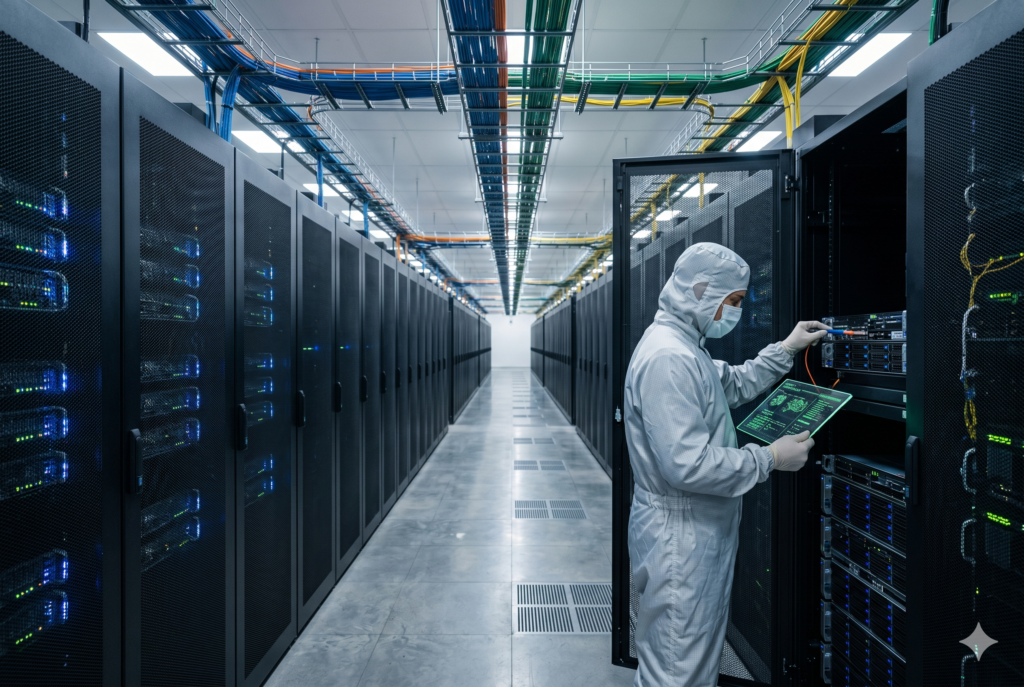
Startups require immense computing power to train advanced localized models. To meet this demand, Saudi Arabia and the UAE are rapidly expanding their GPU clusters. These hyper-scale data centers are specifically engineered to handle intense AI workloads and support complex machine learning operations locally. Access to this local compute power dramatically accelerates startup innovation cycles, ensuring founders no longer have to wait in line for expensive foreign server space.
Overcoming Climate Challenges
Running hyper-scale data centers generates massive amounts of thermal energy, presenting unique climate challenges in the scorching Middle Eastern heat. However, regional developers are turning this hurdle into an innovation opportunity. They are integrating advanced liquid cooling technologies into new facilities and heavily utilizing solar energy grids to power these massive operations. By pioneering sustainable AI infrastructure, the GCC is attracting a new wave of global ESG-focused investors.

Attracting Institutional Capital
This infrastructure boom is acting as a massive magnet for institutional liquidity. Global telecom operators and private equity firms are forming strategic joint ventures with local entities to fund the physical assets required for regional AI dominance. This capital injection transforms data centers into highly lucrative investment vehicles. Venture capitalists recognize the reliable, long-term yields of these hardware investments, resulting in aggressive private equity flows into GCC infrastructure development.
3. Arabic LLMs: Beyond Translation to Cultural Context
Imported AI models routinely struggle with the complexities and nuances of the Arabic language, typically relying on direct translation rather than native comprehension. To solve this, GCC startups are aggressively developing native Arabic LLMs. Native models simply perform better in regional commercial applications, ensuring high accuracy and deep cultural alignment for enterprise clients.
Building Native Intelligence

Native Arabic LLMs are trained entirely on localized, culturally relevant datasets. They understand regional dialects, specific market nuances, and complex idioms in ways that go far beyond basic linguistic translation. Consequently, these models generate insights that actually resonate with local consumers. Startups pioneering these models are quickly securing massive enterprise contracts because they offer a level of precision that Western models cannot match, turning native intelligence into a massive competitive moat.
Enhancing Enterprise Workflows
The business impact of culturally aware AI is profound. Localized models are revolutionizing customer service, financial auditing, and legal document analysis by processing complex Arabic text with unprecedented speed. This intelligence reduces operational friction, automating tasks that previously required extensive human oversight. As enterprise efficiency skyrockets across the region, native LLMs are rapidly becoming the standard operating system for the GCC digital economy.
Preserving Cultural Identity
Foreign AI models inherently carry the cultural biases and ethical frameworks of their creators in Silicon Valley or elsewhere. Relying on them risks diluting regional cultural identity. Sovereign Arabic models actively prevent this algorithmic homogenization by ensuring digital interactions respect local customs and values. This cultural preservation is a strict enterprise requirement for government and educational sectors, helping to build vital trust with the local consumer base.
4. Regulatory Hurdles and Government Backing
Transitioning to a fully sovereign AI ecosystem is a complex regulatory endeavor. Fortunately, GCC governments are actively clearing the path for institutional expansion, providing unprecedented support to startups building localized infrastructure. In this ecosystem, policy actively drives market demand.
Navigating Compliance Frameworks

Data localization laws in the UAE and KSA are becoming increasingly stringent, with enterprises facing heavy penalties for exporting sensitive consumer data. Startups offering compliant, locally hosted AI solutions instantly gain a massive competitive advantage. Regulators are actively working with founders to build secure innovation sandboxes, meaning legal compliance now acts as a powerful catalyst for local innovation rather than a bureaucratic barrier.
Leveraging State-Sponsored Initiatives
Government backing provides critical momentum for the regional AI sector. State-sponsored initiatives offer founders access to non-dilutive capital and subsidized computing credits required to train massive models. This allows startups to aggressively scale operations without sacrificing early equity. With national digitization strategies guaranteeing long-term enterprise demand, founders in the GCC enjoy a level of public-private synergy that severely accelerates their technological timelines.
Fostering Public-Private Synergy
GCC governments don’t just regulate technology; they are its biggest buyers. Government ministries act as massive early-adopter clients for local startups, deploying Sovereign AI across healthcare, security, and urban planning. This creates a highly lucrative B2G (Business-to-Government) revenue pipeline. By securing massive, long-term contracts early in their lifecycles, startups effectively de-risk their business models for future venture capital investment.
5. What This Means for MENA AI Startups
The strategic pivot toward Sovereign AI creates a generational opportunity for MENA founders. As the ecosystem shifts its focus from consumer apps to deep-tech infrastructure, early-stage startups have a clear, highly lucrative mandate: build the enterprise tools that will secure the region’s digital future.
Unlocking New Funding Avenues
Venture capitalists are on the hunt for startups solving localized infrastructure bottlenecks. Seed rounds and Series A investments are increasingly concentrated in B2B AI solutions, with institutional investors demanding clear paths to data sovereignty. Startups that integrate native Arabic LLMs naturally attract premium valuations. In today’s market, capital flows toward tangible infrastructure over speculative consumer software.
Forging Strategic Enterprise Partnerships

The demand for Sovereign AI forces legacy enterprises to modernize immediately. Corporate leaders are actively seeking partnerships with agile regional startups to optimize their supply chains and financial operations using localized algorithms. This creates a direct pipeline for massive B2B software contracts, perfectly positioning MENA startups to architect the GCC’s digital transformation.
Competing on a Global Stage
The GCC is not just building AI for itself; it is creating a blueprint for other emerging markets. As regional startups master the deployment of sovereign, culturally aware models, they are perfectly positioned to export these frameworks to Africa and Asia. The GCC is transforming from a regional tech hub into a global exporter, proving that localized AI can scale internationally and allowing MENA founders to compete on the global deep-tech stage.
Conclusion: Powering an Autonomous Future
The GCC’s aggressive push toward Sovereign AI marks a definitive turning point. By localizing data centers and prioritizing native Arabic LLMs, the UAE and Saudi Arabia are securing absolute digital autonomy. The massive influx of venture capital proves this is not a passing trend, but a sustainable structural shift.
Regional startups are no longer competing on the periphery of the global tech market. Instead, they are actively defining the enterprise standards for localized intelligence. As government initiatives continue to lower entry barriers, the marriage of hardware investments and native intelligence will create a unique economic moat. Ultimately, these foundations ensure the GCC will dictate its own technological future, operating as an independent powerhouse entirely free from foreign digital reliance.



 English